
Logan Keller · 13 September 2026
Analyzing Semantic Clustering Techniques for Enhancing Topical Authority in Specialized Online Platforms
Specialized online platforms rely on semantic clustering to group related content into coherent topical clusters and this approach strengthens signals that search engines interpret as authority within defined subject areas. Researchers have examined how vector-based representations of text combined with algorithms such as k-means and hierarchical clustering allow platforms to organize articles, forum threads, and resource pages without relying solely on keyword repetition. Data from industry analyses conducted through mid-2026 shows increased adoption of these methods across health, technology, and finance niches where precise topical coverage influences ranking stability.
Core Mechanisms Behind Semantic Clustering
Embedding models convert words and phrases into dense numerical vectors that capture contextual relationships so cosine similarity calculations can measure proximity between documents and this process reveals latent themes that keyword lists often miss. Platforms apply dimensionality reduction techniques like PCA or t-SNE before clustering to manage computational load while preserving semantic distances and studies published by the University of Melbourne indicate these steps improve cluster purity by measurable margins in large-scale corpora. Observers note that density-based methods such as DBSCAN handle outliers more effectively than partition-based alternatives in user-generated content environments where noise levels remain high.
Once clusters form, platforms assign representative centroids and link internal pages through contextual anchors that reinforce the same thematic neighborhood. This internal linking pattern distributes authority signals across the cluster and helps crawlers discover comprehensive coverage of subtopics within a single domain. Evidence from platform audits released in September 2026 highlights that sites maintaining tight semantic clusters experienced steadier visibility compared with those relying on broad category taxonomies alone.
Application Across Niche Platforms
Medical discussion forums use semantic clustering to separate threads about treatment protocols from those focused on patient experiences and this separation allows search systems to match queries with higher precision. Technology review sites apply similar grouping to organize hardware benchmarks alongside software compatibility discussions so users encounter layered information without leaving the topical silo. Trade groups such as the Interactive Advertising Bureau have documented how these structures support sustained engagement metrics across specialized communities.
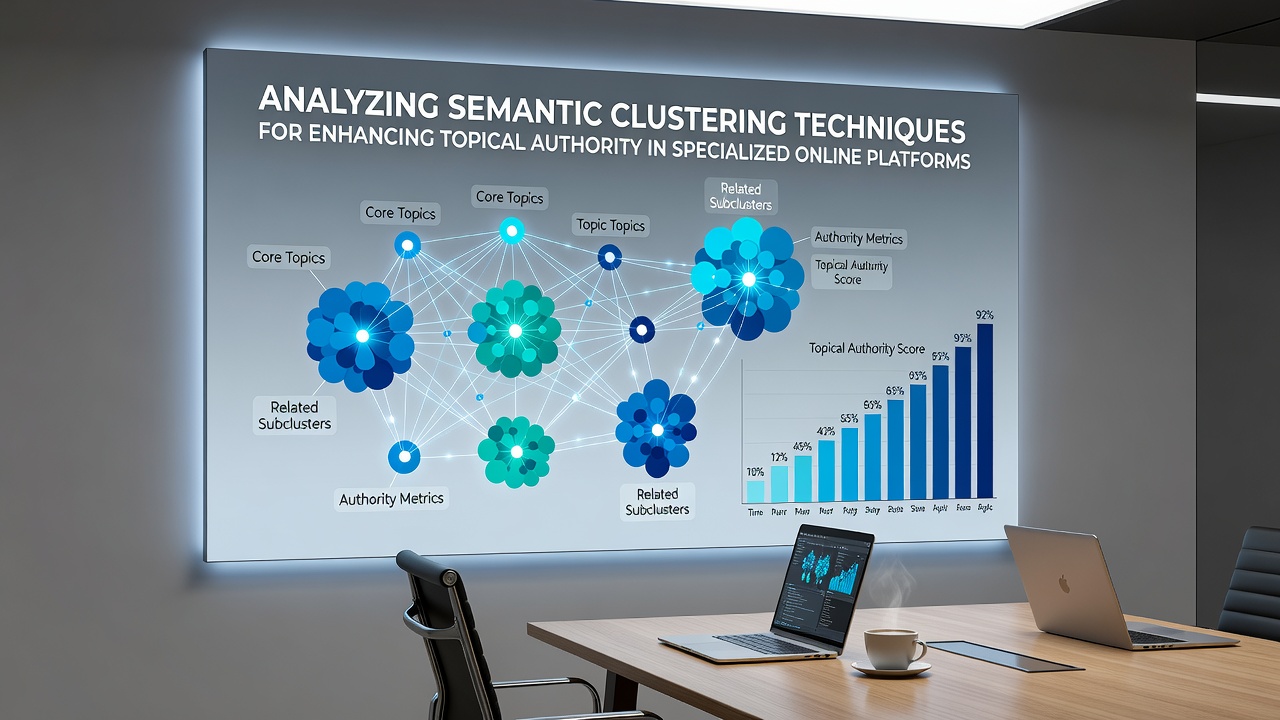
Canadian digital economy reports from 2025 onward note that platforms integrating embedding-driven clustering saw measurable lifts in dwell time and reduced bounce rates within target audience segments. The process begins with corpus preprocessing that removes stop words and normalizes entities before vectorization occurs and subsequent cluster validation often employs silhouette scores to confirm separation quality. Those who maintain these systems update embeddings periodically to reflect evolving language patterns in their verticals.
Measuring Impact on Topical Authority
Topical authority emerges when a domain consistently surfaces for queries spanning a knowledge area and semantic clusters accelerate this by ensuring content depth across related subtopics. Metrics such as topical coverage ratios and entity salience scores provide quantitative views of progress while qualitative assessments come from expert reviews of cluster coherence. Research released by the European Commission's digital single market unit demonstrates correlations between well-formed clusters and improved performance in knowledge panel triggers for niche queries.
Platforms track changes in ranking distributions before and after cluster optimization and data collected through September 2026 reveals that adjustments to cluster boundaries often produce shifts in impression share within three to six weeks. External references from academic repositories further support the observation that hierarchical clustering combined with transformer embeddings yields tighter groupings than earlier bag-of-words approaches. Site operators monitor crawl budget allocation to ensure new cluster members receive timely indexing and this attention prevents dilution of authority signals across unrelated sections.
Implementation Considerations and Data Trends
Specialized platforms begin by auditing existing content inventories to identify gaps within potential clusters and then generate supporting material that fills those gaps with contextually linked information. Automated tools powered by large language models assist in drafting initial groupings although human oversight remains essential for accuracy in regulated verticals. Figures from Australian competition and consumer reports on digital platforms show rising investment in these analytical pipelines among mid-sized sites seeking differentiation.
Integration with knowledge graphs extends the utility of clusters by connecting platform content to external entities and this linkage strengthens entity recognition by major search providers. Periodic re-clustering accounts for language drift and new terminology introduced by community contributions and platforms that schedule these updates quarterly report more consistent topical performance. The reality is that computational requirements scale with corpus size yet cloud-based vector databases have lowered barriers for smaller operators.
Conclusion
Semantic clustering techniques continue to shape how specialized online platforms build and maintain topical authority through structured content organization and measurable internal linking. Platforms that apply embedding models alongside validated clustering algorithms create environments where search systems readily identify comprehensive coverage and this alignment supports sustained visibility. Ongoing data collection through 2026 and beyond will likely refine best practices as embedding quality and evaluation methods advance across geographic markets.